In a previous post I showed that for any closed region $\Omega$, the integral of the outward-pointing surface-normal unit vector $\hat{n}$ over its boundary is zero:
$$\displaystyle \int_{\partial\Omega} \hat{n}\,dS = \int_\Omega \nabla 1 \,dx = 0 $$
This post will explore a counterintuitive consequence of this fact. Suppose instead that we want the same integral, but over a surface $\Sigma$ that is not the boundary of some region $\Omega$. For example, either $\Sigma_1$ or $\Sigma_2$ in the picture below:

Both surfaces have the same boundary curve $\Gamma$, and clearly the surfaces and their normal vectors are quite different. But it turns out that the integrated normals are identical. To see this more easily, imagine both surfaces are placed on top of the red surface (like a lid placed onto an open box), to form two closed regions:
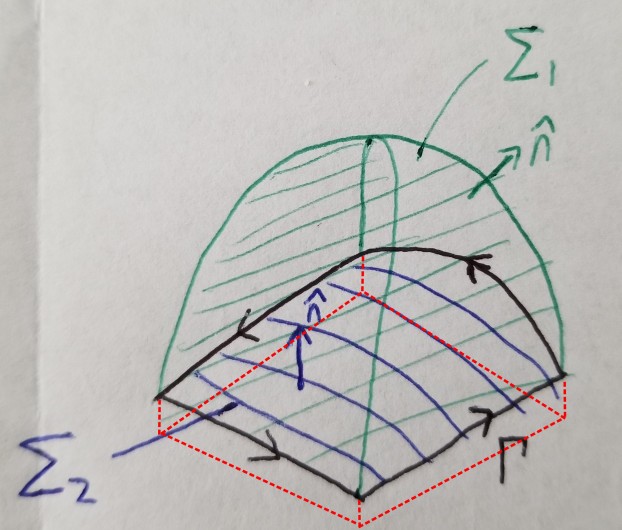
Since these two regions are closed, the integrated normal vector over each is zero:
$$\displaystyle \int_{\partial\Omega_1} \hat{n}\,dS = 0 = \int_{\partial\Omega_2} \hat{n}\,dS $$
But these two new surfaces are identical except for the $\Sigma_1$ and $\Sigma_2$ parts, so the integral of $\hat{n}$ over the non-identical portions (namely $\Sigma_1$ and $\Sigma_2$) must be identical. Therefore the integrated normals over $\Sigma_1$ and $\Sigma_2$ themselves must be equal:
$$\displaystyle \int_{\partial\Sigma_1} \hat{n}\,dS = \int_{\partial\Sigma_2} \hat{n}\,dS $$
And since we didn’t impose any constraints on the surfaces $\Sigma_1$ and $\Sigma_2$ except that they share the same boundary curve $\Gamma$, we have the surprising conclusion that for any two surfaces with the same boundary curve, the integrals of the outward unit normal vectors are equal.
But what do they equal? Since the actual result of the integral doesn’t depend on the surface but only on its boundary curve, it must be some quantity related to that. But which quantity?
Stokes’ Theorem
This situation may remind you of Stokes’ theorem (also known as the curl theorem to distinguish it from the more general theorem of that name):
$$\displaystyle \int_{\Sigma} \nabla\times\vec{F}\cdot\hat{n}\,dS = \oint_\Gamma \vec{F}\cdot d\vec{s} $$
Stokes’ theorem involves the surface normal component of the curl of some vector field and reduces it to a line integral over the surface’s boundary curve. To find an analogue to Stokes’ theorem relevant to our case though, we need the quantity integrated over the surface to be a vector (namely $\hat{n}$), not just one component of a vector. For this we will need to work with a more complicated object than a vector field and it will be convenient to use index notation, in which Stokes’ theorem reads:
$$\displaystyle \int_{\Sigma} \epsilon_{ijk}\frac{\partial F_k}{\partial x_j}\hat{n}_i \,dS = \oint_\Gamma F_k\,ds_k $$
Instead of a vector field $F_k$, we will use a tensor field $F_{kp}$, and apply Stokes’ theorem separately to each $p$ index:
$$\displaystyle \int_{\Sigma} \epsilon_{ijk}\frac{\partial F_{kp}}{\partial x_j}\hat{n}_i \,dS = \oint_\Gamma F_{kp}\,ds_k $$
All we need to do now is choose $F_{kp}$ such that:
$$\displaystyle \epsilon_{ijk}\frac{\partial F_{kp}}{\partial x_j} = \delta_{ip} $$
so that the integrand on the left-hand side of Stokes’ theorem becomes just the normal vector $\hat{n}_p$. Then plugging in the special $F_{kp}$ the right-hand side will provide our answer
Choosing $F_{kp}$
Fortunately choosing $F_{kp}$ is fairly straightforward. Since:
$$\displaystyle \delta_{ip} = \begin{cases} 1 & i = p \\ 0 & i \neq p \end{cases} $$
we can take each $p$ index separately and write a condition for $F_{kp}$. For example, with $p=1$:
$$\displaystyle \epsilon_{ijk} \frac{\partial F_{k1}}{\partial x_j} = \nabla\times F_{\cdot ,1} = \delta_{i,1} = \begin{bmatrix}1 \\ 0 \\ 0 \end{bmatrix} $$
So we’re really just looking for a vector field whose curl is $[1,0,0]$. There are many, but we’ll pick a fairly simple one:
$$\displaystyle F_{k,1} = \frac12\begin{bmatrix} 0 \\ -x_3 \\ x_2 \end{bmatrix} $$
In the same fashion, we can and will choose:
$$\displaystyle \begin{aligned} F_{k,2} &= \frac12\begin{bmatrix} -x_3 \\ 0 \\ x_1 \end{bmatrix} \\ F_{k,3} &= \frac12\begin{bmatrix} -x_2 \\ x_1 \\ 0 \end{bmatrix} \end{aligned} $$
Putting it all together and viewing $F_{kp}$ as a matrix, it looks like:
$$\displaystyle F_{kp} = \frac12\begin{bmatrix} 0 & -x_3 & -x_2 \\ -x_3 & 0 & x_1 \\ x_2 & x_1 & 0 \end{bmatrix} $$
which is a cross-product matrix between the vector $\vec{x} = [x_1, x_2, x_3]$. Switching back to index notation, we have:
$$\displaystyle F_{kp} = \frac12 \epsilon_{kpq} x_q $$
Let’s confirm that this actually meets the condition we need it to:
$$\displaystyle \begin{aligned} \epsilon_{ijk}\frac{\partial F_{kp}}{\partial x_j} &= \epsilon_{ijk} \frac{\partial}{\partial x_j} \left( \frac12 \epsilon_{kpq} x_q \right) \\ &= \frac12\epsilon_{ijk}\epsilon_{kpq}\delta_{qj} \\ &= \frac12(\delta_{ip}\delta_{jq} – \delta_{iq}\delta_{jp})\delta_{qj} \\ &= \frac12\left( 3\delta_{ip} – \delta_{ip} \right) \\ &= \delta_{ip} \end{aligned} $$
So it does in fact work. Now plugging it back into Stokes’ theorem, we get:
$$\displaystyle \begin{aligned} \int_{\Sigma} \hat{n}_p \,dS &= \int_{\Sigma} \epsilon_{ijk}\frac{\partial F_{kp}}{\partial x_j}\hat{n}_i\,dS \\ &= \oint_\Gamma F_{kp}\,ds_k \\ &= \oint_\Gamma \left( \frac12 \epsilon_{kpq} x_q \right)\,ds_k \\ &= \frac12\oint_\Gamma \vec{x}\times d\vec{s} \end{aligned} $$
So there you go! Note that this works only for surfaces embedded in three-dimensional space, because a) we used Stokes’ theorem which involves the curl, curl being defined only in 3D; and b) the boundary of the surface needed to be a 1D curve in order to obtain a line integral. To prove similar statements about higher-dimensional surfaces would require a different proof tactic, if any such statements are even true to begin with. That may be the subject of a future post so stay tuned.